


For decades, refrigeration design has been driven by energy efficiency, capital cost and environmental legislation. Today, another factor is rapidly becoming just as important operational resilience.
Increasingly frequent heatwaves, rising energy costs, labour shortages and higher customer expectations are exposing the limitations of traditional refrigeration strategies. The question is no longer simply how efficiently a refrigeration s
ystem performs under normal conditions, but whether it can continue to protect products, maintain sales and keep stores trading when conditions become more demanding.
Across Europe, retailers are adapting to this reality. Following recent periods of extreme heat, several major supermarket groups have announced investment in refrigeration systems capable of operating in ambient temperatures of 45°C, recognising that the climate in which stores were originally designed is changing.
However, designing larger refrigeration plants raises another important question. Is increasing the size of the refrigeration system the most effective long-term investment or should retailers rethink how refrigeration is delivered?
The UK and much of Europe have experienced record-breaking temperatures over recent years. Heatwaves that were once considered exceptional are becoming more frequent, longer in duration and more intense. Retail infrastructure, however, was largely designed around historic climate data.
As outdoor temperatures increase, centralised refrigeration systems are placed under greater pressure. As these operating pressures increase, refrigeration efficiency falls and compressor energy consumption rises. Research consistently shows that store temperature and air conditioning performance have a direct influence on supermarket refrigeration energy use and system performance.
The result has become increasingly visible during summer heatwaves. Stores have experienced refrigeration failures, chilled cabinets taken out of service, temporary cabinet closures and reduced product availability as refrigeration systems struggle under extreme conditions. Recent heatwaves prompted several leading retailers to accelerate investment in higher-temperature refrigeration equipment and more resilient refrigeration infrastructure. For retailers, this is no longer simply an engineering challenge. It is becoming a commercial risk.
When Refrigeration Stops, Sales Stop
Every hour that chilled or frozen products remain outside their required operating temperature increases the likelihood of product disposal, emergency engineering intervention and lost revenue.
The products most affected are often the highest-value and fastest-moving categories:
- Fresh meat and poultry
- Dairy products
- Ready meals
- Chilled drinks
- Sandwiches
- Fresh convenience foods
- Frozen foods
- Ice cream
These are also the products customers are most likely to visit the store specifically to purchase. The financial impact therefore extends well beyond the value of the discarded stock. When customers find empty chilled cabinets or refrigeration units taken out of service, many choose to complete their shopping elsewhere.
The retailer loses:
- The chilled product sale.
- The remainder of the customer’s shopping basket.
- Customer confidence.
- Future repeat business.
The cost of refrigeration failure is therefore measured not simply in engineering repairs, but in lost revenue, reduced customer loyalty and operational disruption.
The Traditional Response
The refrigeration industry has responded logically. If higher ambient temperatures reduce refrigeration performance, then increase the capability of the refrigeration plant.
Many new supermarket specifications now include:
- Larger condensers.
- Higher-capacity compressors.
- Increased refrigerant charge.
- Higher design ambient temperatures.
- More sophisticated controls.
Larger refrigeration plants consume more energy, require larger condensers, contain more refrigerant, require more maintenance and introduce additional mechanical complexity throughout the life of the installation.
In simple terms, larger refrigeration plants cost more to purchase, cost more to install and cost more to operate. This naturally leads to a different question. Is There Another Way? Rather than asking:
“How do we build a refrigerat
ion system capable of surviving 45°C?”
Perhaps the better question is:
“Why do we not create the ideal store environment for refrigeration?”
Research has shown that store temperature has a direct influence on refrigeration performance and energy consumption. Maintaining a stable indoor environment improves refrigeration efficiency, while poor air conditioning performance increases refrigeration load.
Likewise, studies have shown that the heat rejected from refrigerated display equipment has a significant influence on building cooling and heating requirements, reinforcing the need to consider refrigeration and air conditioning as one integrated system rather than separate building services.
The Novum Philosophy
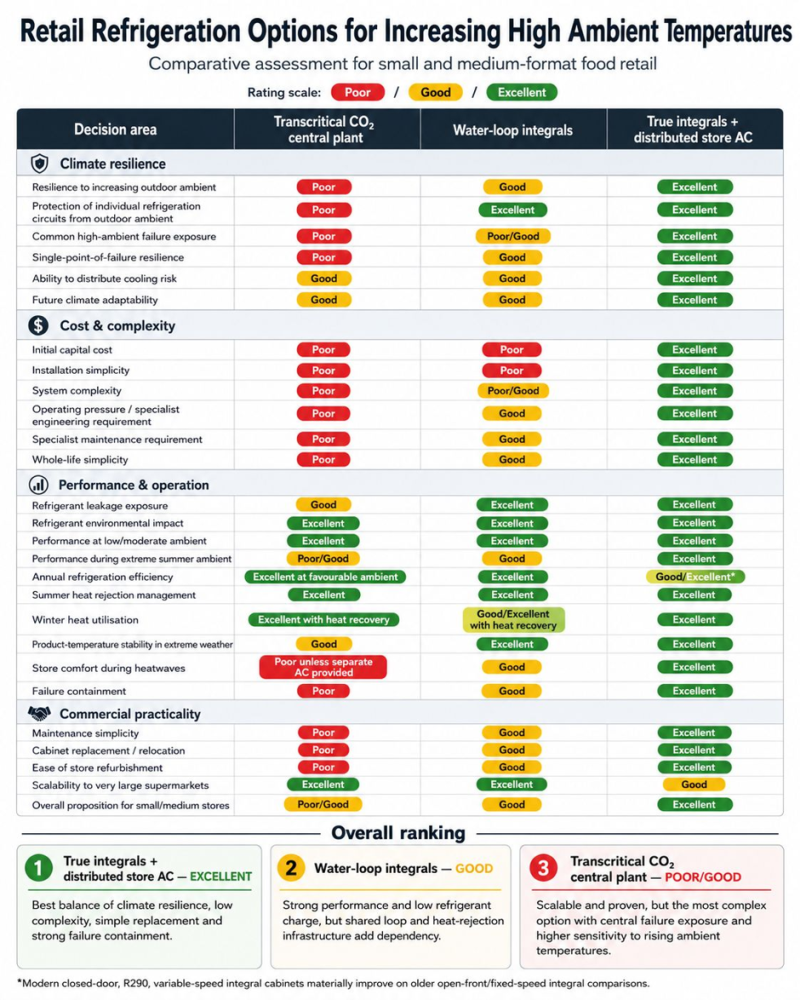
Novum believes operational resilience begins by reducing complexity rather than adding it. Instead of concentrating refrigeration solutions, Novum distributes refrigeration throughout the store using independent, factory-tested plug-in systems.
- Instead of increasingacity alone, Novum focuses on reducing heat rejection through high-efficiency R290 refrigeration while supporting performance with a well-designed air conditioning system.
- Instead of lengthy on-site repairs, Novum pioneered removable cassette refrigeration, allowing cabinets to be returned to service within minutes.
- Instead of waiting for failures to occur, Novum is introducing a new wireless predictive monitoring capable of identifying developing faults before they become operational failures.
Each innovation addresses a different source of operational risk. Together they form a layered resilience strategy designed around one objective: Keeping retailers trading.
Layer One – Rethinking Where to Invest
As retailers review refrigeration specifications for 45°C ambient conditions, the natural response is to increase the capability of the refrigeration plant. This typically means larger condensers, larger compressors, additional refrigerant charge and more powerful refrigeration systems. While this improves performance during periods of extreme heat, it also increases the capital cost of the installation and the energy required to operate it throughout its life.
Novum believes there is a more balanced approach. Rather than investing solely in refrigeration plant designed to cope with a handful of exceptionally hot days each year, retailers should consider investing in the store environment. A well-designed air conditioning system delivers benefits far beyond refrigeration. It maintains a stable internal climate, improves customer comfort, enhances colleague wellbeing and creates the conditions in which refrigerated cabinets operate most efficiently.
Is it better to spend more on refrigeration or to create an environment where refrigeration naturally performs better? Novum’s latest generation of R290 plug-in cabinets has been specifically engineered with low heat rejection which has a close connection to Novum model ultra-low energy consumptions, meaning the additional cooling demand placed on the building is significantly reduced compared to alternative integral displays.
This allows retailers to adopt a different investment strategy. Instead of specifying larger refrigeration plants or expensive water-loop infrastructure, investment can be redirected towards building climate control.
Layer Two – Reduce Dependence on Central Plant
A central refrigeration plant supplies multiple display cases through extensive refrigeration pipework. While this approach has served the industry for many years, it also means a significant plant fault has the potential to affect an entire line-up of cabinets.
Novum takes a different approach. Each refrigerated cabinet is a complete, independent refrigeration system. If one cabinet requires attention, every other cabinet continues operating normally. The result is a refrigeration estate that is naturally more resilient because the risk is distributed rather than concentrated.
Operational disruption becomes isolated rather than widespread. For retailers, this means product availability is protected even when maintenance is required.
Layer Three – Factory-Tested Performance
Reliability begins long before equipment reaches site. Every Novum cabinet is completely assembled, charged and performance tested before leaving the factory. The refrigeration circuit has already demonstrated its performance under controlled manufacturing conditions.
This significantly reduces installation variability and commissioning risk. The retailer receives refrigeration performance that has already been proven rather than created entirely during site installation.
This philosophy becomes increasingly important as skilled refrigeration labour becomes more difficult to secure throughout the globe. Reducing site complexity improves consistency. Consistency improves reliability, reliability improves resilience.
Layer Four – LEAP™ Cassette Technology
Every mechanical system will eventually require maintenance. Compressors wear. Fan motors fail. Electrical components reach the end of their operational life. The question has never been whether components fail. The real question is. How quickly can the cabinet return to service?
This challenge led Novum to pioneer removable cassette refrigeration. Today this philosophy continues through our LEAP™ Technology. Rather than diagnose the failure, request spare parts for the manufacturer and replace and repairing the case a number of days have gone by. With Novum LEAP™ a spare unit can be taken from back of house disconnected and swapped within minutes. Traditional maintenance focuses on repairing equipment. LEAP™ focuses on restoring operation.
Layer Five – Predictive Rather Than Reactive
The most resilient refrigeration system is one that identifies problems before they affect trading. Novum’s can provide a wireless monitoring platform that represents the next stage in this philosophy.
Continuous monitoring of cabinet performance enables developing faults to be identified long before temperatures begin to rise. Abnormal compressor operation. Extended run times. Temperature drift. Fan performance. Defrost abnormalities.
Each provides valuable information reg
arding cabinet health. Instead of waiting for an operational failure, maintenance providers receive early notification, allowing intervention during planned visits. Maintenance becomes predictive rather than reactive.
Layer Six – Continuous Operational Intelligence
Connected refrigeration creates knowledge. Every cabinet continuously contributes operational data. Across an estate of hundreds or thousands of cabinets, this information becomes a powerful engineering resource. Performance trends can be identified.
Recurring issues become visible.
Maintenance strategies evolve.
Future cabinet designs improve.
Operational resilience therefore becomes a process of continuous improvement rather than a fixed equipment specification. Each connected cabinet helps improve the reliability of every future installation.
A Different Philosophy
The refrigeration industry is understandably responding to climate change by designing refrigeration systems capable of operating at higher ambient temperatures.
Novum is responding differently.
- Instead of concentrating refrigeration into larger and more expensive central plants, why not invest a faction of that into store environment that comes with it less operational risk.
- Instead of making maintenance more complex, Novum are making recovery faster.
- Instead of continually increasing refrigeration capacity and operating cost, Novum is providing sufficient operational savings.
- Instead of choosing centralise plant due to longer life expectancy, Novum offers monitoring to keep assets to optimum operational condition and upgradable cassettes to provide latest level of efficiency and performance.
This layered philosophy is what differentiates Novum. Each layer removes another source of operational risk. Together they create something far more valuable than refrigeration equipment.
 English
 French
 German
 Italian
 Polish
 Spanish
